
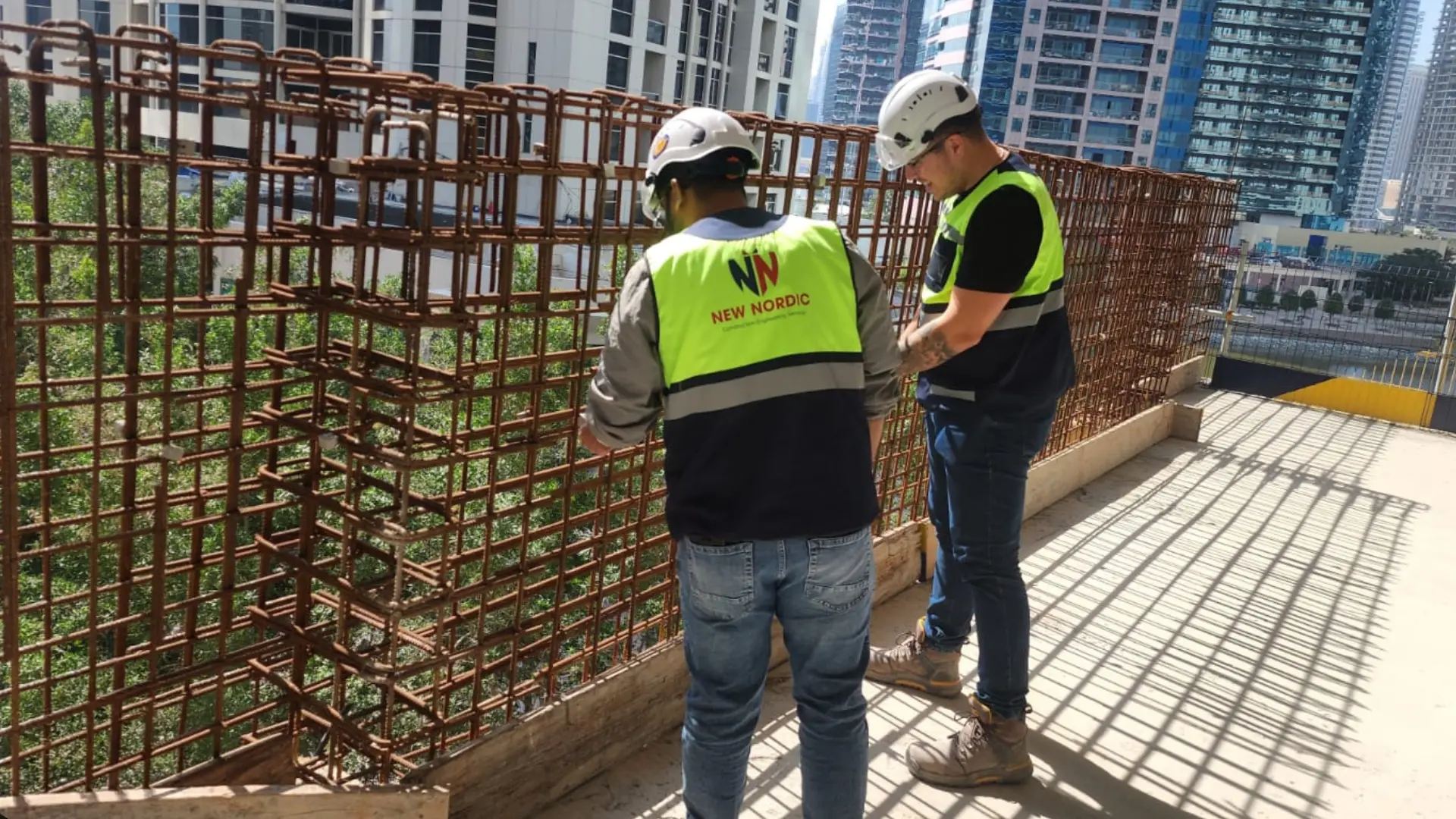
Material Testing
Concrete coring, laboratory analysis and material strength assessment to ASTM standards - chloride content, carbonation depth, compressive strength and cover.
Quick Answer
New Nordic carries out concrete coring and laboratory material testing to ASTM standards - establishing actual compressive strength, chloride content, carbonation depth and cover so structural condition is confirmed by evidence, not assumption.
Laboratory results turn an inspection into a quantified engineering position, and underpin durability, service-life and remediation decisions.
Who This Is For
- - Building owners
- - Consultants & contractors
- - Developers
- - Insurers
When It Is Needed
- - Confirming concrete strength
- - Assessing corrosion risk
- - Before remediation design
- - Quality disputes
What Problems This Service Solves
Assumed material properties lead to wrong decisions. Laboratory testing replaces assumption with measured, defensible values.
Unknown Concrete Strength
Design strength is not actual strength decades later. Core testing establishes real compressive strength.
Chloride Contamination
Chlorides drive reinforcement corrosion. Profiling reveals how far contamination has penetrated toward the steel.
Carbonation Advance
Carbonation neutralises concrete's protection of rebar. Depth testing shows how close it has reached reinforcement.
Inadequate Cover
Low cover accelerates corrosion. Testing confirms cover against design and code requirements.
Quality Disputes
As-built quality claims need proof. Laboratory results provide defensible evidence for disputes.
Remediation Design Gaps
Repairs designed without material data fail. Test results give the basis for durable remediation.
The Testing Process
Test Plan
Sampling strategy and standards within 48h
Core Extraction
Targeted coring with minimal disruption
Laboratory Analysis
Strength, chloride and carbonation to ASTM
Engineering Review
Results interpreted against design and code
Test Report
Quantified findings with recommendations
Methods & Equipment
Sampling is carried out in-house and analysed to recognised ASTM standards, keeping the chain of custody and accountability with one team.
Compressive Strength (ASTM C42)
Laboratory strength testing of extracted concrete cores.
Chloride Profiling (ASTM C1152)
Chloride content versus depth to assess corrosion risk.
Carbonation Depth
Phenolphthalein testing of how far carbonation has advanced.
Cover Measurement
Confirms concrete cover to reinforcement against design.
Petrographic Analysis
Microscopic examination of concrete condition and deterioration.
Sulfate & Cement Content
Chemical analysis of the concrete matrix where required.
What You Receive
Every New Nordic engagement produces bespoke engineering deliverables - not a template. Where applicable, work is stamped by a qualified professional engineer and accepted by Dubai Municipality.
Laboratory Test Report
Certified results to applicable ASTM standards
Strength Findings
Actual compressive strength versus design requirements
Chloride & Carbonation Data
Contamination and carbonation profiles by depth
Cover Results
Measured cover assessed against code requirements
Durability Implications
What the results mean for corrosion and service life
Engineering Recommendations
Actions informed by the measured material data
Why New Nordic
In-House NDT Equipment
All key equipment owned and operated in-house - no delays waiting for subcontractors.
48h Mobilization
Engineers on site within 48 hours of signing for urgent structural work.
PI Insurance Active
Professional Indemnity Insurance active on all engagements. Client protection built in.
One Responsible Partner
From inspection to certification to remediation - single accountability throughout.
Related Services
NDT Testing
In-house GPR, UPV, Half-Cell and Impact-Echo non-destructive testing with no subcontractors.
Durability Engineering
Assessment of long-term performance, corrosion risk and maintenance planning for harsh UAE exposure.
Structural Service Life
Assessment of remaining structural service life to inform maintenance and investment decisions.
Frequently Asked
Why test concrete that looks fine?
Visual condition does not reveal strength loss, chloride contamination or carbonation. Only laboratory testing confirms what is happening inside the concrete.
How much coring is required?
We take the minimum sampling needed for statistically meaningful results, target representative locations, and make good all core holes afterwards.
Which standards do you test to?
Recognised ASTM standards including ASTM C42 for core strength and ASTM C1152 for chloride content, among others as required.
Can material testing settle a quality dispute?
Yes. Certified laboratory results provide defensible, independent evidence of as-built material quality.
Is testing available standalone?
Yes - we provide material testing both within a full assessment and as a standalone service for consultants and contractors.
Ready to Start
Talk to Us About Material Testing
Send us your building details. Our engineers will review and provide a detailed proposal within 48 hours.